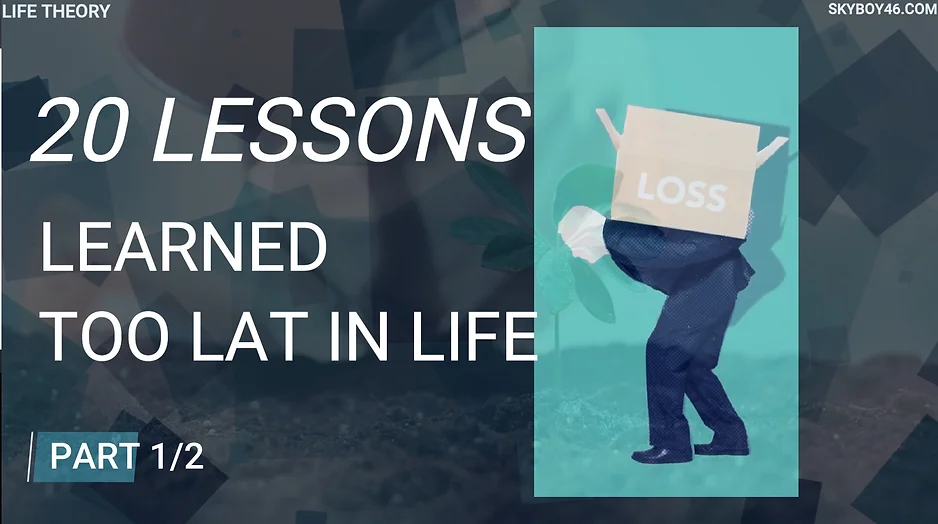
How do you navigate life’s turning points? Explore the quarter-life crisis and learn how to anchor your life to your values rather than fleeting passions. Discover how to identify your guiding principles and transform uncertainty into clarity. Are you ready to find your compass?
SUBSCRIBE: https://www.youtube.com/@LifeTheory46
VISIT: https://linktr.ee/lifetheory46
Get You Monthly Life Stories in Advance & Our Premium Learning Packs HERE:
Navigating Life’s Turning Points
Picture this: a moment when you stop and look around, wondering if the path you’re on is truly your own or one carved out by circumstance. It’s a familiar scene for many—one that echoes through generations, yet it feels uniquely urgent today. The idea of an identity crisis isn’t new, but what’s striking is how young it’s starting to manifest. We’ve all seen the tropes about midlife crises—the flashy motorcycles, the dramatic makeovers—but let’s zoom in on an earlier turning point, the quarter-life crisis, which has quietly become a rite of passage for younger generations.
Back in 2017, a LinkedIn survey revealed that nearly 75% of millennials between 25 and 33 had experienced this existential crossroad, with the average age pegged at 27. That was before the pandemic reshaped our world, so it’s safe to say those numbers might be even higher now. Compare this to the 10–20% of individuals facing midlife crises, and it’s clear we’re seeing a shift. Why the earlier reckoning? The answer isn’t just about timing; it’s about the pressures and complexities of modern life.
Think about it: decades ago, life followed a straightforward formula. Go to school, land a steady job, get married, raise a family, and eventually retire. Options were limited but predictable. Expectations were clear. Today, the landscape has evolved into an overwhelming array of choices, driven by a global marketplace and a relentless hustle culture. Career paths aren’t just about earning a living anymore; they’re about passion, fulfillment, and self-expression. Yet, ironically, this freedom can leave many paralyzed, unsure how to choose the “right” path.
At its core, this crisis is about identity and purpose. Many of us didn’t grow up in environments that encouraged us to explore who we are or what we value. Without that foundation, we’re left to figure it out as adults, often amidst chaos and uncertainty. And when life doesn’t offer clear direction, we crave stability more than ever.
This need for structure and predictability is rooted in human nature. As children, we rely on routines to feel safe and grounded. That longing doesn’t vanish as we grow older—it just becomes harder to fulfill in a world that feels increasingly unpredictable. From economic instability to global crises, the modern era challenges our ability to plan and dream with confidence.
For younger generations, much of this crisis centers around careers. According to the same LinkedIn survey, 61% of respondents cited struggles with finding a job they’re passionate about as the primary source of their quarter-life crisis. But what if the issue isn’t passion at all?
Enter Adam Grant, a renowned organizational psychologist, who offers a refreshing perspective. Instead of chasing fleeting passions, he suggests anchoring your life to your values—those steady, unchanging principles that act as your inner compass. Passion, he argues, is a luxury that not everyone can afford. It’s often fickle, driven by momentary interests rather than lasting purpose. Values, on the other hand, provide clarity and direction, helping you build a meaningful life regardless of circumstances.
So how do you uncover these guiding principles? Start by reflecting on the people you admire. What traits stand out? Are they compassionate, disciplined, adventurous? Write down their names and the qualities you respect. These attributes likely align with your own core values.
If this feels daunting, don’t hesitate to ask trusted friends or family members for their perspective. Sometimes, others see strengths in us that we overlook. Alternatively, explore lists of common values and note which resonate deeply with you—concepts like integrity, growth, creativity, or independence.
Dr. Russ Harris, author of The Confidence Gap, suggests that identifying your values is more accessible than you might think. Once you do, they can act as a steadfast guide, helping you navigate not only career decisions but every aspect of life.
The quarter-life crisis is uncharted territory, but it’s also an opportunity. By embracing your values as your compass, you can transform uncertainty into clarity. Yes, the world is unpredictable, but with a firm grip on what matters most to you, every step forward becomes more intentional.
Life doesn’t come with a map, but you don’t need one. You’ve got your compass, and that’s more than enough. So, keep moving forward, guided by what truly defines you—and until next time, keep on rising.
–> Read More Life Stories Here:
https://www.lifetheory.us
https://www.lifetheory.eu
Buy all of our Life Stories & Our Premium Learning Packs. Listen or Read to them anytime you want. Have them Forever.
You can get each monthly lesson on our website at https://www.skyboy46.com/store
SHARE THIS STORY
Visit Our Store
SHOP NOW
www.skyboy46.com & www.myskypet.com
Designed For Pet Lovers & Introverted Souls
Sport, Hobbies, Motivation, Music & Art





~EXPLORE MORE~
www.linktr.ee/skyboy46